Will this be the AI podcast apocalypse?
Who isn’t dreaming of a hallucinating voice in their ear?
Newsletter #17
Hang around for some Big 4 “cost efficiency opportunities”
A word from the person behind the laptop
Happy Monday!
A lot of news since last newsletter: OpenAI released a new model, Mira Murati leaves OpenAI and OpenAI received a new crazy valuation. I promise the content of this newsletter is not OpenAI related though, but perhaps its not a good sign that a lot of this is not product related stuff (while Claude Sonnet 3.5 is quietly becoming a personal favorite for many).

Today’s theme: we’ll be diving into the Deloitte report on how GenAI is being used in the legal industry.
And like everybody else I’ve been playing around Notebook LM from Google which means I’ve actually created a podcast that runs through the main conclusions if you dont have time to read through it yourself.
Note: If there was a problem with the hyperscale of podcast production before because you’d only have to get a mic, then this problem is about to explode because of NotebookLM.
Amazing tool though!
Check out the result:
The future is (probably) already here
I thought I’d never have to slave myself through another consultant report from a Big 4 firm after I quit, but this report from Deloitte gives some pretty good insights into what lawyers themselves expect from GenAI at this point.
We’re at the point where everyone acknowledges GenAI will reshape legal work, but the product hype isn’t exactly matching up. GenAI companies oversell, and lawyers are left unimpressed when the products don’t deliver. Meanwhile, a whole army of legal professionals is already using ChatGPT and Claude to handle basic tasks, often under the radar.
So what do the lawyers think themselves?
What does the report say?
Firstly, the report was written based on interviews with not only attorneys and court room lawyers, but also other people from corporate law: Deloitte basically conducted an online survey from February to March 2024, targeting senior legal leaders (e.g., GCs, Heads of Legal) to understand Generative AI's impact on corporate legal departments.

Find the full report here.
The survey gathered responses from 43 leaders across industries like Financial Services, Technology, Life Sciences, and Energy, representing legal departments of various sizes (from under 25 to over 200 employees) with participants from the US, Europe, and the UK. So a lot is covered here. So far so good!
Benefits
Let’s start with the benefits - and surprise, surprise: the Big 4 consultancy says it represents a so-called “cost efficiency opportunity”.
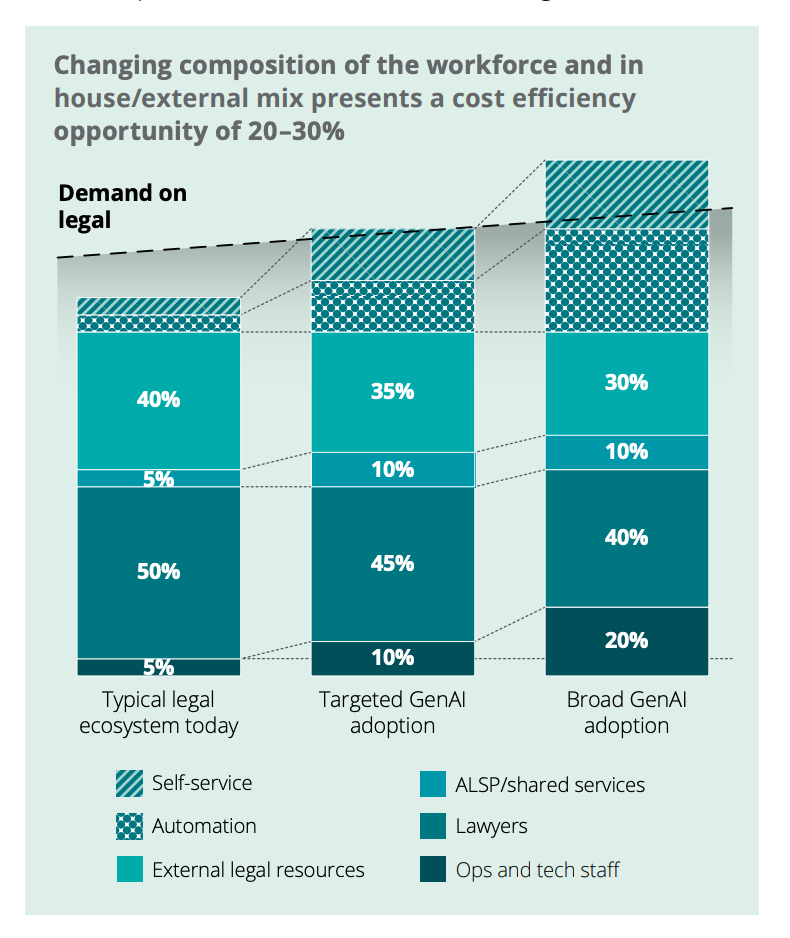
GenAI (like all other technology) represents a cost efficiency opportunity.
I don’t want to spend too much time on the cost efficiency because that’s a story we’ve all heard by now either as “AI will steal your job” or “this process can be optimised”. Less time spent on each task = cost efficiency.
Efficiency aside (and this is where I think it gets interesting) the report focuses on GenAI’s ability to improve the day-to-day experience for both lawyers and clients alike. For lawyers, this means less time on routine, mind-numbing tasks and more on strategic, meaningful work - which, Deloitte found, could even boost morale, with 60% of respondents expecting an uptick in job satisfaction.
I mean, they might end up disappointed, but it’s interesting that people aren’t necessarily worried about losing their jobs (and in my opinion probably shouldn’t be); instead, they’re excited at the prospect of focusing on more engaging tasks.
Next up, GenAI also has the potential to reshape how legal departments engage with the broader business. Imagine AI-powered chatbots delivering quick, clear legal guidance or an AI-driven "legal front door" that streamlines access to essential information. This can perhaps eliminate legal’s reputation from bottleneck to a more “valued” sparring partner (to put it politely).
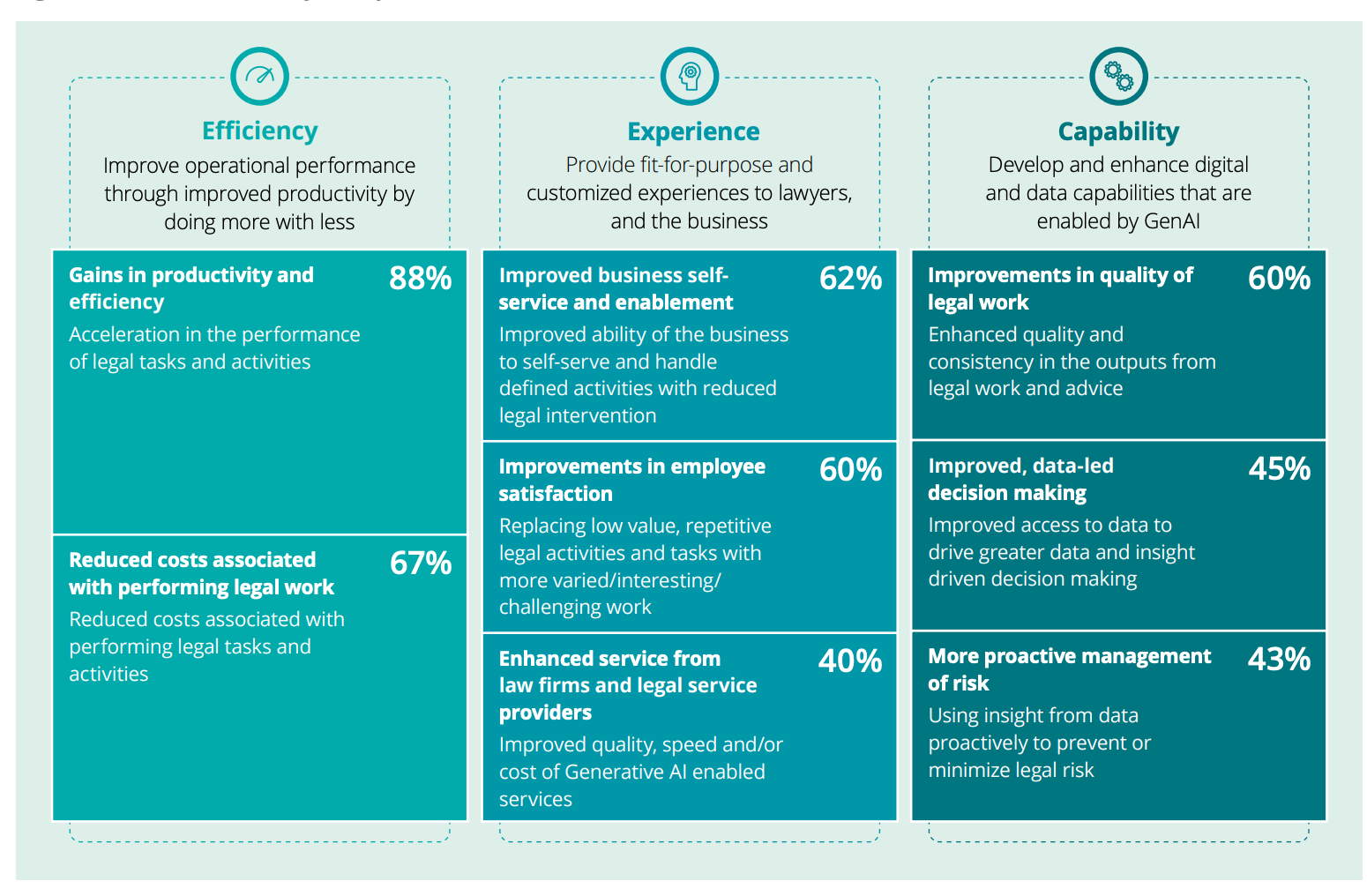
From Deloittes report
Last but not least, GenAI might push lawyers to focus more on data. If you can identify patterns in litigation and investigations, it could give you a competitive edge. The report notes that:
“Better access to, and insight from, legal and business data will enable more data-led decision making and more proactive risk management by legal teams.”
But knowing law firms, data hygiene probably hasn’t exactly been a top priority over the years, so there’s likely a big cleanup needed to make the most of the data they’ve accumulated - and that could take years if the expertise doesn’t exist within the organisation.
Now let’s talk about risks
There has been a lot of focus on risk. Perhaps also a bit too much in my opinion, but the report also mentions what some of the risks factors for legal are.
The biggest barriers to Generative AI adoption, according to the survey, are the usual suspects: financial and resource constraints, plus the challenge of making a strong business case - especially with the tech still being so new. The report states that:
A slim majority of our respondents report no budget having yet been made available for Generative AI initiatives, restricting the ability of legal teams to meet their objectives and timelines.
This is really weird in an area with so much capital, but I guess the reason for not priorising would be “why fix something that is already working” so competetion will hopefully be the real driver of investments here.
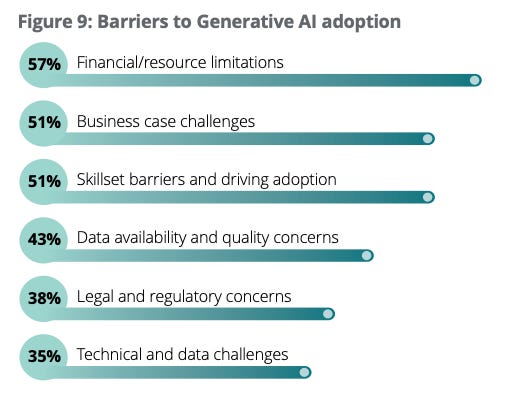
Then there’s a big “skills” when it comes to getting Generative AI off the ground. It’s not just about adopting the tech, but also about making sure legal teams know how to actually use it. That means for example training staff on how to prompt AI effectively, understand its capabilities, and tackle the ethical questions that come with it. It might also involve bringing in fresh talent with AI and data science expertise.
I’ve been teaching AI to lawyers, and it’s interesting how many are more focused on the regulatory aspects than the actual application of the technology. Of course, that makes sense - it’s what we’re trained for - but it’s still curious that when something has the potential to completely transform how we work, the primary concern is how it’s regulated.
Which brings me to the next point: regulatory and compliance risks
I’m honestly surprised that only 38% mentioned this as a barrier. In my conversations with legal professionals, it feels like the biggest concern, especially when it involves external vendors. I’ve even heard from startups in the legal AI space that they’ve stopped mentioning AI entirely when pitching to clients - too many get spooked by the regulatory and confidentiality issues. Instead, they just focus on showing the functionality and skip the “AI” label altogether.
Last but not least
The report is definitely worth a read - or you can listen to the “homemade” podcast I shared earlier. But keep in mind, a lot has changed since the data was collected, and things are moving fast in this space. The benefits and risks might look a little different today.
One piece of advice that still holds true: experiment with these tools yourself. It’s the only way to really understand the pros and cons firsthand.
In other news…
“Dollar, Dollar Bills, Y’all”
OpenAI's valuation just hit a staggering $157 billion, thanks to its latest funding round. Investors are betting big on the company’s continued dominance in AI, despite questions around profitability. OpenAI will also be moving away from their non-profit structure.
AI regulation in California
California Governor Gavin Newsom officially vetoed the widely supported SB 1047 which I wrote more extensively about in another newletter. Newsom expressed concerns over its implementation and potential impact, putting a stop to legislation that many believed would bring significant changes to state policy.
Start-up of the week
This week’s pick is a little different: Casetext isn’t exactly a startup anymore. Founded over a decade ago, Jake Heller, the founder, is sharing insights on the opportunities for vertical SaaS in the legal space and how they made it work. A lot has changed in the 10+ years since they launched and the last couple of years everything has changed.
Extra toppings
Is privacy dead?

LLMs for LL.Ms: practical observations on AI, law, and building legal technology. Roughly twice a month.
Originally published on Substack →