Law students are quietly rewriting legal education with AI
Will universities (and businesses) catch up?
Newsletter #25
Read to the end for a free trip to Prague
A word from the person behind the laptop
At a law faculty in Aarhus, a third-semester student is founding an AI association because his curriculum doesn’t mention technology at all.
In Copenhagen, a young legal associate is building a startup to help students navigate their own university.
And in Prague, a law lecturer has already decided that generative AI is “the new business-as-usual” in her classroom.
Together, they sketch a picture of legal education in transition: AI is everywhere in the profession, but still only patchily present in law school.
I’ve always been drawn to what happens at the universities. Partly because of my role as an external lecturer, but also out of pure interest in “what’s going on” with law students right now.

People (in this case law students and teachers) will shape the future of law more than AI will. So how are they actually working with AI and what do their teachers make of it? For this issue, I spoke to two students, Philip and Julius, and to a teacher who is already redesigning her class around AI, Barbora.
Students taking AI into their own hands
When Philip Haakon Dalmose looked at the job market, one thing felt obvious: whatever else happens in law, AI isn’t going away.
“Employers expect a certain degree of AI literacy in their new hires” says Dalmose, a third-semester law student at Aarhus University. Yet on his campus, “there are currently no courses related to AI or technology available in the curriculum.”
So he did what law schools have not yet done. He started a student association dedicated to AI in law, with the explicit goal of “future-proofing” at least part of their education.
“Employers expect a certain degree of AI literacy in their new hires,”
The association draws a wide range of students. From master’s students who already use tools to first-years who are openly skeptical and “critical of integrating AI into their schoolwork.” The common denominator, Dalmose suspects, is uncertainty surrounding technical qualifications needed and how to apply them in practice.
Over the next year, the association plans a series of practical, case-based events where students can try out legal AI platforms on realistic problems. A hands-on laboratory that doesn’t yet exist in the official curriculum.

Philips association markets itself with a focus on AI, but also legaltech in general
Cheating and AI use isn’t the same
Dalmose’s project is also about creating a space for honesty.
He says that, right now, conversations about AI use “rarely come up at all.” Those who do rely on AI tools often hesitate to admit it. Worried either that they’ll be seen as having discovered a “secret sauce” for grades, or dismissed as lazy.
“I’m sure many fellow students can attest to having met others who have labeled AI use as ‘laziness’ or ‘cheating,’” he says. Some classmates have gone further, making it “their mission to avoid the use of these tools at any cost, even refusing to incorporate them in exams where generative AI is allowed.”
“I’m sure many fellow students can attest to having met others who have labeled AI use as ‘laziness’ or ‘cheating.’”
His impression is that most law students still “rarely use AI in any context or situation, whether it be work, school, or personal assistance.” In that sense, he thinks, existing exam rules, often restrictive or cautious about AI, “correlate with how students work with AI in general.”
That, he adds, is precisely what he hopes will change.
“AI is already deeply integrated into many of our future workspaces,” Dalmose says. The question is whether universities will help students prepare. Else they’ll have to figure it out themselves.
Perhaps universities are not that different from regular jobs in that regard.
Course chaos calls for AI solutions
A few hundred kilometers away in Copenhagen, another law student has responded differently to the same sense of mismatch between what students need and what their institutions provide.
“I’m building an AI student assistant that is able to compile course data, peer reviews, etc. to help students make more informed decisions faster,” says Julius Sejersen, a legal intern at a big Danish law firm who is about to finish his master’s degree at the University of Copenhagen.
The tool is meant to solve a very practical problem: basic orientation, not law. In Denmark, he explains, students must often “navigate 5–10 websites/platforms, social media etc. just to get the information needed to make informed decisions.” His goal is simple: “I would like to change that.”
“I think that we as lawyers in the future will be evaluated heavily on our AI skills, maybe as much as on the skills we’ve traditionally learned.”
Sejersen sees plenty of “healthy” AI use among his peers. Students use tools to tighten their language, sharpen arguments, and create their own study materials. Flashcards, exam questions, and structured notes. “Here, there are real opportunities for optimizing your studies,” he says.
But he is also worried about habits of mind.
“With the current state of AI, especially in the field of law, it is a little dangerous,” he says. The risk, as he sees it, is that students make AI their first instinct instead of their last.
“You quickly get used to asking some kind of chatbot as the first step instead of actually applying the correct methodology,” he warns. “If you get used to AI from day one of law school, and that AI hallucinates (and does so very convincingly), I fear that we will educate less competent lawyers in the future.”
For Sejersen, the answer is better AI, and better training.
“I expect law firms to invest in good tools and to invest heavily in educating their employees,” he says. Being a first mover in the AI space, he believes, will be “critical for future growth.” Asked whether he would choose an employer based on its AI strategy, he doesn’t hesitate: “To put it very simply: I would.”
In fact, he goes even further. “I think that we as lawyers in the future will be evaluated heavily on our AI skills, maybe as much as on the skills we’ve traditionally learned,” he says. For junior lawyers in three to five years, “it is paramount that you have strong AI skills” if you want to be among the best.
Is this what the future classroom looks like?
If students like Dalmose and Sejersen are building from the bottom up, Barbora Obračajová is one of the teachers trying to redesign legal education from the perspective of a teacher.
Barbora - or Baru - teaches Modern Lawyers, a small, data-driven legal design class at the Faculty of Law at Charles University in Prague. For her, generative AI is already “the new business-as-usual.”
To my question about what it’s like to teach AI to law students right now, she responds enthusiastically:
“I love that!” she says. GenAI and vibecoding have dramatically lowered the bar for students to get something concrete on the table. Before, her students were making mockups in Canva and stitching screens together in MarvelApp. Slow, manual work before they could even show what they had in mind.
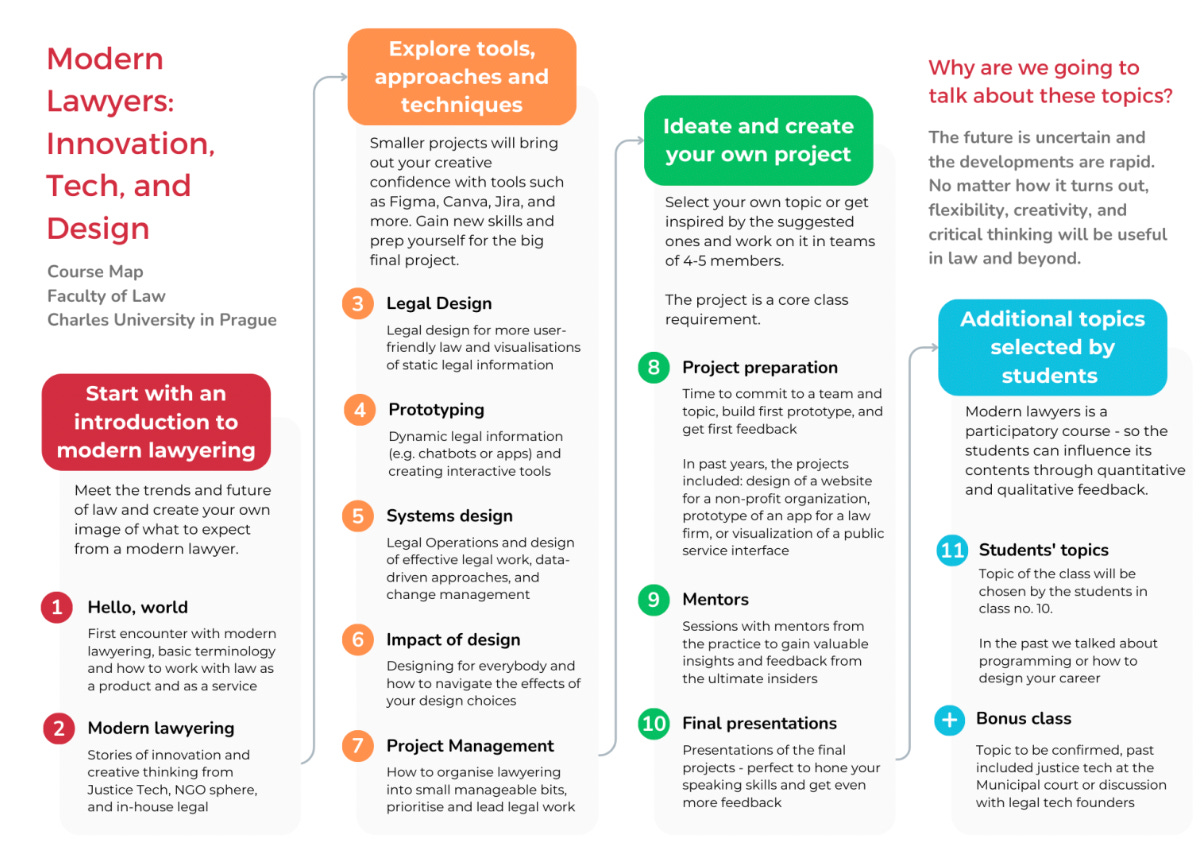
Barboras structure as described on her website
Now, she says, “we can get prototypes off the ground much quicker, be it clickable vibecoded apps, playing with different information architecture of legal documents, or generating imagery to illustrate the steps in a legal service. Our iteration is faster, discussions are more aligned, and we can focus on the ideas with much less friction.”
Reflections on what the tools can and cannot do also go deeper “when you can play with it in real time alongside others.”
“For me, cheating is the absence of thought process.”
The reception from students is, in her words, “very positive.” She collects feedback throughout the semester, and students are keen to learn with GenAI and to discover new tools and use cases.
But she also sees two recurring challenges.
First, nerves before the first class. Her format is different from a traditional law lecture “we play, riff, and move tables,” as she puts it, so she starts with small, simple challenges before turning up the difficulty.
Second, a distinct kind of AI FOMO. With GenAI moving fast and only ninety minutes a week together, “we only manage to cover a tiny part.” Students often wonder whether they’re “getting the most of the tech.” She recognises the feeling herself and treats “learning to navigate the ambiguity” as part of the skill set.
On her blog, she describes similar patterns: students using AI to explain concepts, restructure long legal texts, or prototype tools and then using class time to debate whether the outputs actually make sense.
Agency will be the main driver
Baru is careful not to overgeneralise. Modern Lawyers is a small elective, not a full curriculum.
“I do not have the data to make a generalized statement, as I teach only a small elective,” she notes when I ask her to compare her classroom to faculties where AI is barely visible. Every semester, she has a couple of students who have never really used AI before “or maybe once or twice” and a few “hyper power users that vibe with Claude Code like a pro.”
“There is definitely a range,” she says. “Not to be fixed, but to be designed for.” Her course is one part of a much larger ecosystem that, in her view, has to make room for every level of proficiency and interest: those who dive deep into AI, and those who barely touch it.
When the discussion turns to cheating versus innovation, she doesn’t start with tools at all she starts with meaning.
“For me, cheating is the absence of thought process,” she says.
Generative AI makes it trivial to produce plausible outputs, and that “puts a new kind of pressure on us as educators to formulate the value of a task.” Instead of trying to block AI, she argues, teachers should design assignments so that students can “ethically flex all of their muscles and focus on the process of making.”
“creating a space for safe and productive exploration is the first and most important purpose of higher education.”
“If the task is uninspiring and hollow or the students do not see the point in spending time on it either because there is none or it has not been well communicated. There will always be ingenious ways to minimize workload to give the space to more impactful things.”
Her own internal benchmark is concrete: “If a student gives me 18+ hours of their life, they should get and feel like they are getting something from it.”
That connects to how she sees her students: not children to be policed, but adults with agency. “My students are adults in charge of their own learning journeys. So if they see the value in doing something properly, I see that they will do so.”
“Ultimately, for me this is a question of meaning and value in giving assignments, not necessarily in policing cheating,” she says and then adds a caveat that reveals a lot about her approach. “But I also teach legal skills, not legal clauses, which is a different sport.”
Where Philip describes a culture in Aarhus where many students hide their AI use, Barbora insists that openness has to be actively designed into the course.
“To me, creating a space for safe and productive exploration is the first and most important purpose of higher education,” she says. University is the time when students can “prototype different careers and directions, and rely on the university safeguards if and when they fail at something.”
That kind of environment, she stresses, “does not just happen, it needs to be proactively sculpted.” If the space is not designed for openness, “students are not going to start trusting and sharing out of the blue.”
So she treats hospitality as part of the pedagogy: making people feel welcome, seen, and comfortable, down to “the tiniest of details, like learning the students’ names, celebrating pivots and mistakes. Including my own.”
One concrete exercise that works well is simply to ask students to use AI to create something outright bad. It deliberately tones down the pressure to be perfect, opens up room for pivots, and signals that the point is to explore and reflect, not to present flawless outputs to the professor.
For the future of law school she’s cautiously optimistic but very aware of the constraints.
“This level of cultural innovation needs to be happening at all levels so it will depend on which uni we are talking about, who are the leaders, ambassadors, and spaces in play,” she says. And the ground keeps moving: “the status quo is changing almost weekly, which makes planning challenging.”
There’s a tension to manage. “On one hand, with the pace of new tech, we need to be flexible and agile. At the same time, we are influencing people, so anything we do and teach should be grounded and informed.” That is “a lot of work and a lot to keep up with alongside your teaching and research practice, or a day job.”
For universities, that means creating “spaces for exploration and experimentation as well as reflection and sharing of best practices” and making those spaces realistic enough that ordinary teachers can actually use them.
Shaping the future
Across their differences, all three voices converge on one point: AI is already reshaping the legal profession faster than law schools are changing. Perhaps even faster than the early adopters can follow along.
Whether universities can catch up, and whether they should move closer to Dalmose’s mandatory AI assignments, Sejersen’s warnings about overreliance, or Baru’s data-driven sandbox, is still an open question.
For now, the future of AI in legal education may be decided by what students and a handful of teachers do in the margins: an association meeting after class, a prototype built as a side project, a small seminar where AI is treated not as a threat, but as homework.
LLMs for LL.Ms: practical observations on AI, law, and building legal technology. Roughly twice a month.
Originally published on Substack →