Law students don't care about your AI strategy
I did my own research to find out
Newsletter #26
Read to the end for an idea
A word from the person behind the laptop
Every time someone asks me about AI adoption among law students, I’ve given the same answer: they’re ahead of the average. Younger people adopt faster. Studies back it up. My own conversations with students backed it up.
Then I actually conducted a survey to find out.
A few weeks ago, Harvey and Legora both announced partnerships with top US and UK law schools. Stanford, Cornell, Oxford, King’s College London. Free access, curriculum integration, the works. Harvey is now in 25+ American law schools. Legora just launched its Legal AI Scholars Program at nine more.
You’d think AI is about to eat legal education whole if you look at those partnerships.
But then I surveyed 53 Danish law students. I talked to student associations, posted on Facebook like a proper boomer, and joined the friday bar at KU.
The gap between those two realities is what this story is about.
How I collected the data
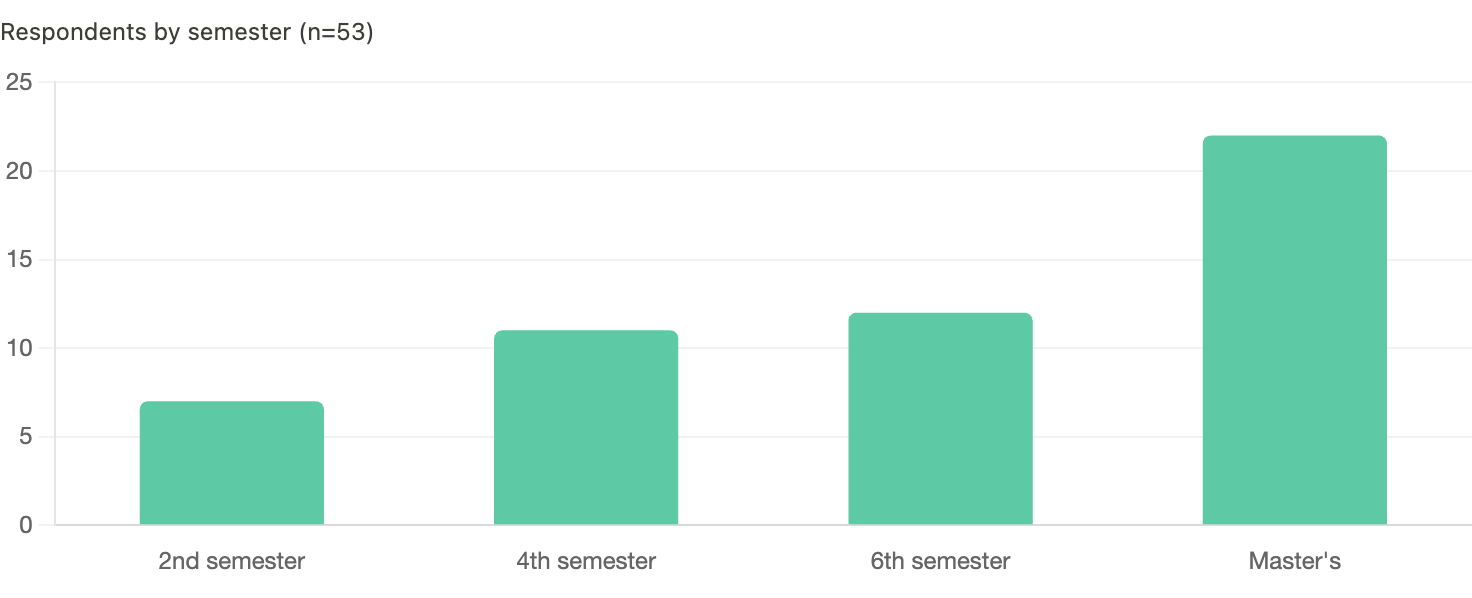
I surveyed 53 Danish law students across semesters and campuses and had a more in depth qualitative convo with 5 more.
The survey was in Danish, distributed through student networks, AI-focused groups, and yes, in person at a friday bar. I wanted a mix. Not just the AI-curious crowd, but the people who don’t think about this stuff at all. Semester distribution covers everything from second-semester undergrads to students finishing their master’s degree.
I’m not going to pretend 53 responses is a representative sample of all Danish law students. It isn’t. But it’s enough to spot patterns and confirm some assumptions I had.
AI is shadow IT in the classroom
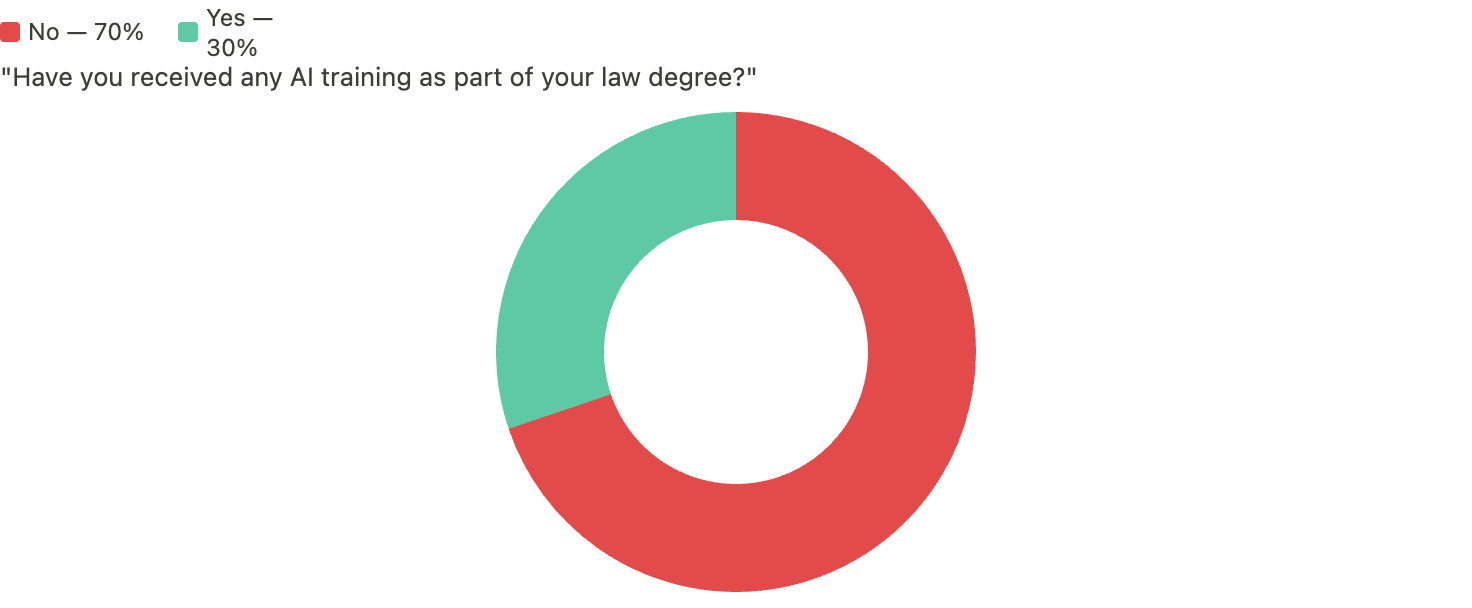
The first question was simple: have you received any form of AI training as part of your law degree?
70% said no.
That tracks with what I saw during my own time as an external lecturer, and with what Philip Dalmose told me when I interviewed him for the newsletter back in March. He founded a student AI association in Aarhus specifically because there were zero technology courses in the curriculum. “There are currently no courses related to AI or technology available,” he said at the time.
It doesnt surprise me that this hasn't changed much. The 30% who said yes is probably inflated by the fact that some respondents came through AI-focused student networks. If I’d only surveyed at the friday bar, I suspect it would be closer to 20%. In other words around the general population average.
A win for Sam Altman
Sam Altman has had a rough few weeks with Anthropic launching new functions every 3 hours and winning a bigger chunk of the market plus some wild accusations in this piece by The New Yorker. When I asked which tools students use, the answer was overwhelmingly one thing: ChatGPT.
Perhaps he would be happy to know that he’s winning student consumer in Denmark. Or perhaps he doesn’t care. I do though.
43 out of 53 respondents use ChatGPT. That’s 81%. The next most common tools were Microsoft Copilot and legal-specific platforms like Legora, Harvey or Pandektes (a local DK company), both around 25%. Claude came in at about 21%.
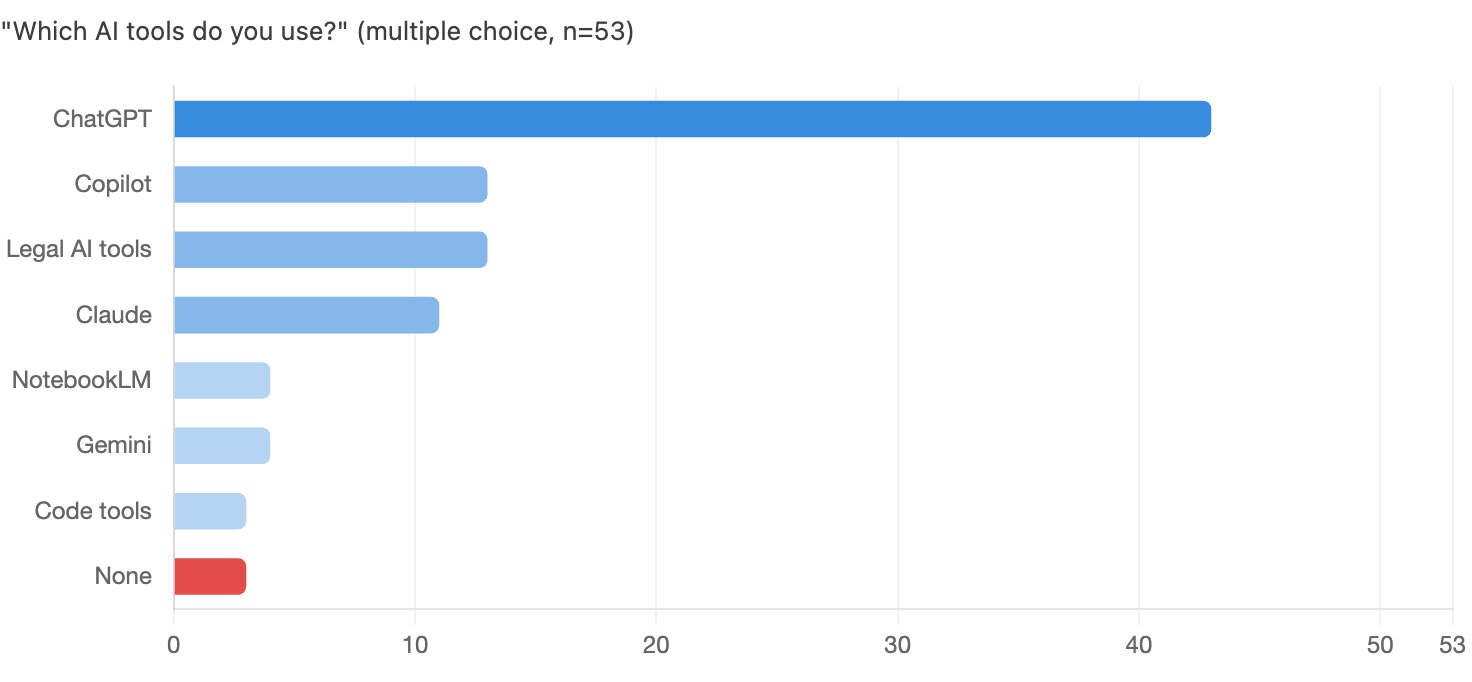
But look at it from the other direction: Roughly a third, use ChatGPT and nothing else. Three respondents don’t use any AI tools at all. The “multi-tool” user who has ChatGPT, Claude, Copilot, and a legal AI platform open in different tabs? That person exists in this dataset, but they’re the exception.
One student told me “AI just doesn’t take up that much attention”.
For many of these students, AI is ChatGPT, and ChatGPT is something you occasionally ask a question when you’re stuck. Either as part of studying or something else, but the legal workflows are not top of mind for many students.
The frequency picture is less dramatic than you’d think
About 43% of respondents say they use AI daily. That sounds high until you remember that “daily use” for a student might mean asking ChatGPT to put together a recipe for a nice spag bol.
It doesn’t necessarily mean they’re running contract analysis or doing legal research with it.
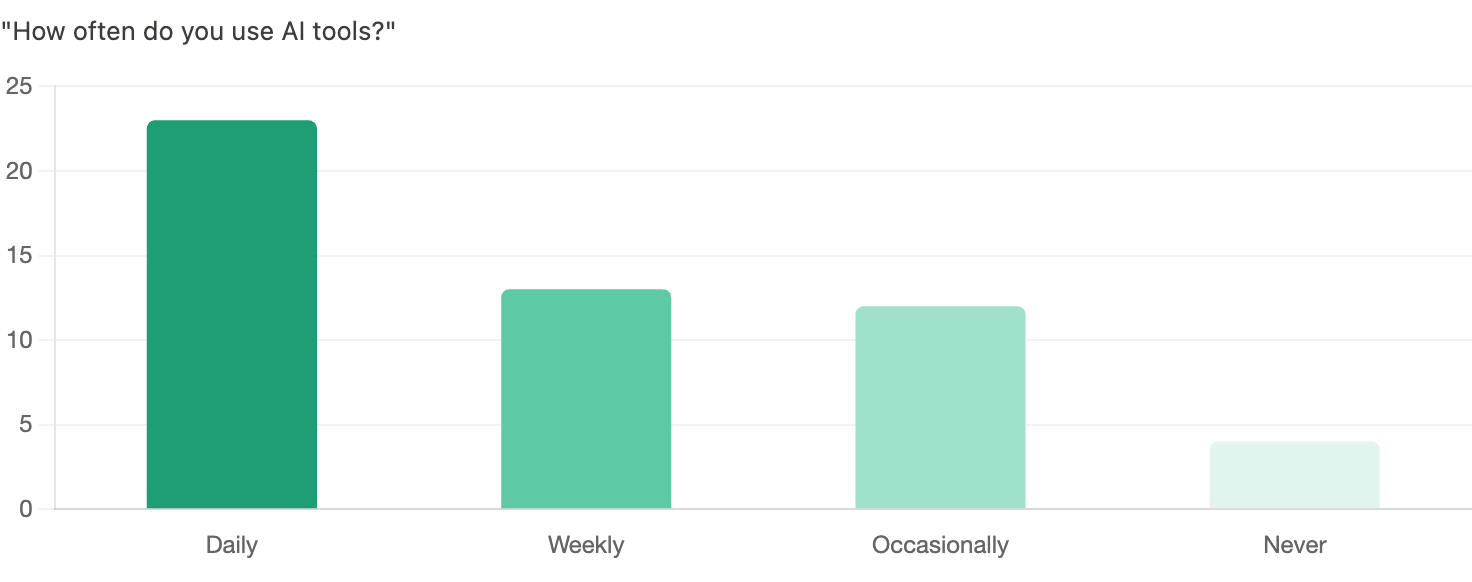
23% use AI weekly. Another 23% say “once in a while.” And 8% never use AI tools at all.
When I was teaching, adoption felt slightly lower than this, but it really hasn’t changed as much as I expected over the last couple of years. I think that says something about what drives adoption in the first place.
It’s curiosity and willingness to spend time getting familiar with the tools. Without a structured reason to learn, most students default to whatever is easiest and most familiar. Right now, that means ChatGPT in the browser used casually.
What they actually want help with
The most requested training area, by far, was legal research. 42 out of 53 respondents picked it. Case analysis came second at 25, followed by workflow automation at 21 and general AI understanding at 20.
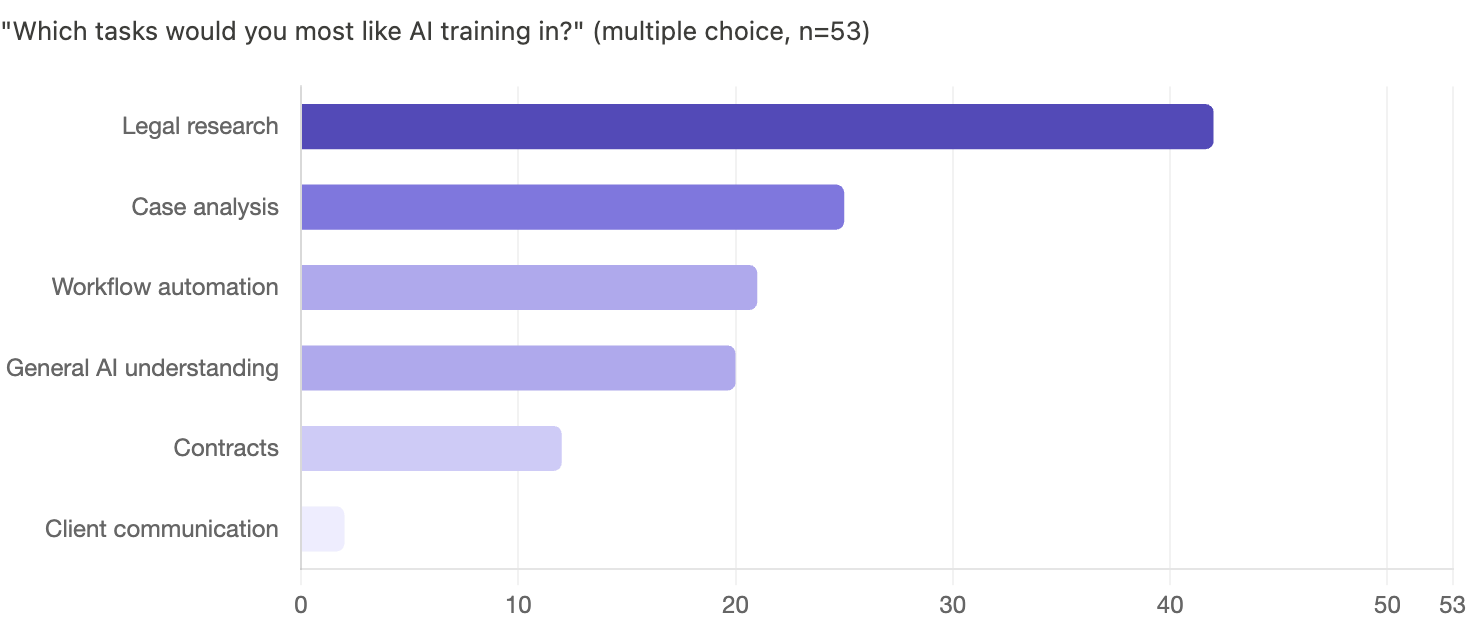
Students are saying, pretty clearly, that they want AI for legal research specifically. But they’re mostly using ChatGPT, which is a general-purpose tool that wasn’t built with Danish case law in mind.
The question is why. Is it because they’ve tried legal research tools and found them insufficient? Or is it because they haven’t tried them at all and are projecting what they think they’d want? I suspect it’s mostly the latter. The tools exist, but the awareness of the tools is still low based on my experience and the reponses to the survey,
This is obviously the gap the Harvey and Legora law school partnerships are trying to close. But those partnerships are currently being rolled out at Stanford and Oxford, not at Aarhus or Copenhagen. Danish law students are, for now, largely on their own.
Why nobody has cracked this market yet
Firstly, I want to say this: students are a notoriously awkward group to sell to.
On paper, they’re the perfect early adopters. Curious and digitally native. But they’re also mostly broke. Paying €500 per seat for a legal AI platform might be achievable for some trustfund kids, but no one else.
Even my own survey data points the same way: when I asked what students would pay for a one-day AI workshop, plenty of answers landed at “0”. A couple even wrote that they expected it to be included in tuition.
That leaves two paths.
One is the direct-to-student free tier, which is basically what ChatGPT already is. The general-purpose tools have won this battle by default. They’re free, they’re good enough for most student tasks, and there’s zero switching cost.
The other is going through the university, which is what Harvey and Legora are trying to do in the US and UK. That works, but it’s slow.
Faculties have their own procurement cycles, their own agendas, and a healthy fear of getting locked into a vendor that raises prices 20% a year once the students who trained on it start working at law firms. There are also real quality and academic integrity concerns that an enterprise sales pitch doesn’t always address well. Does the tool hallucinate on Danish case law? How do exam rules handle it? Who owns the data students put into it?
They’re going to evaluate carefully, argue about it in committees, and probably move slower than the market expects.
Which brings us back to the students, who in the meantime will just keep using ChatGPT. And get familiar with the platform which means even more usage in the long run.
The employer question
I expected students to care about whether their future employer has an AI strategy. The data says otherwise.
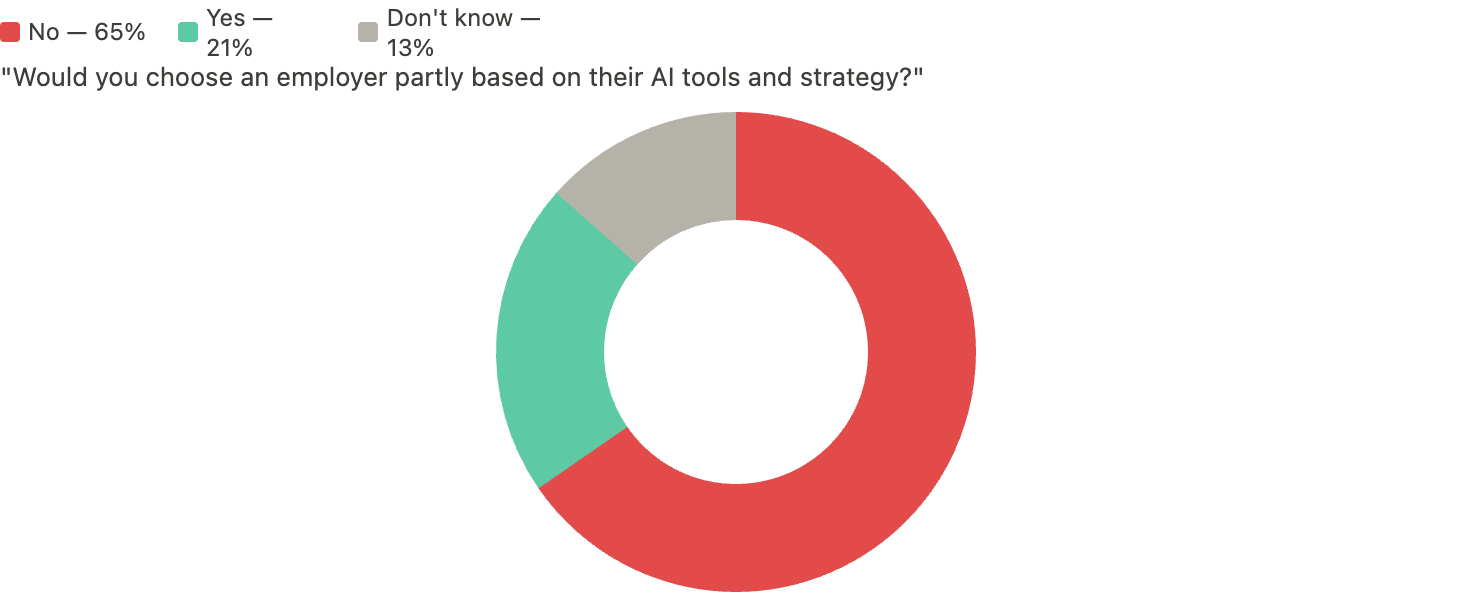
64% said no. Only 21% said they’d factor an employer’s AI tools into their decision. When I interviewed Julius Sejersen for the March edition, he said the opposite: “To put it very simply, I would.” But Julius was building an AI startup alongside his degree. He’s probably not the median respondent here.
For most students, AI is still something that happens in the background. A nice-to-have, not a deciding factor when you’re picking between law firms. This might change once they actually start working and realize that the firm down the hall has tools that save four hours a week on due diligence. For now, it doesn’t really register.
Turns out law students care about... law. Who would have thought.
So are we overestimating student adoption?
Based on this data, I think the honest answer is: yes, a little.
The narrative around legal AI tends to zoom in on the early adopters. The Philip Dalmoses and Julius Sejersens of the world, the students founding AI associations and building legal AI startups. Those stories are real and worth telling. I told them myself in the March edition.
But they’re not representative. The median Danish law student uses ChatGPT a few times a week, has never touched a legal-specific AI tool, has received no formal AI training, and doesn’t particularly care whether their future employer has an AI strategy.
And unsurprisingly it’s not that different from adoption patterns in working law firms, where the gap between what’s theoretically possible with AI and what lawyers actually do on a daily basis remains wide. Anthropic's labor market research puts daily AI adoption in legal practice at around 15%, against a theoretical capability of 80%. Students are just mirroring the profession they're about to enter.
An idea
Students want legal research capabilities but don’t have access to the right tools.
Most students want training but their universities aren’t providing it. They’re curious but not curious enough to invest significant time on their own.
What some AI curious students might actually need is a smaller, more practical community. If 5-10 law students meet regularly to discuss tools, build demos and want to get familiar with the intersection of law and AI, perhaps that will enable them to move to the next level.
Not a course with credits and exams and not a platform partnership, but something more like a study group including mentoring.
I’m considering setting something up myself. It wouldn’t be affiliated with any university, just an open group where students can work with the different tools together, and build solutions.
The demand is there, and based on my conversations there's clearly a segment that has picked up on AI and is ready to move faster than their surroundings allow. This would be for them.
If you’re a law student and that sounds like something you’d show up for, just shoot me a message via Linkedin and I’ll be in touch.
LLMs for LL.Ms: practical observations on AI, law, and building legal technology. Roughly twice a month.
Originally published on Substack →