AI Field guide 2: Good vibes and solution mode
There’s actually quite a few actions you can take today
Newsletter #29
Read to the end for some free input on how to chin up before AGI hits
A word from the person behind the laptop
Last newsletter was a pretty bleak and all about the current challenges that AI bring to professional legal services. This week is different.
Let’s have a look at some of the potential solutions that can be implemented to support with the transition to so-called “AI native” operations.
Photo by Denis Ignatenko
Are lawyers tokenmaxxing?
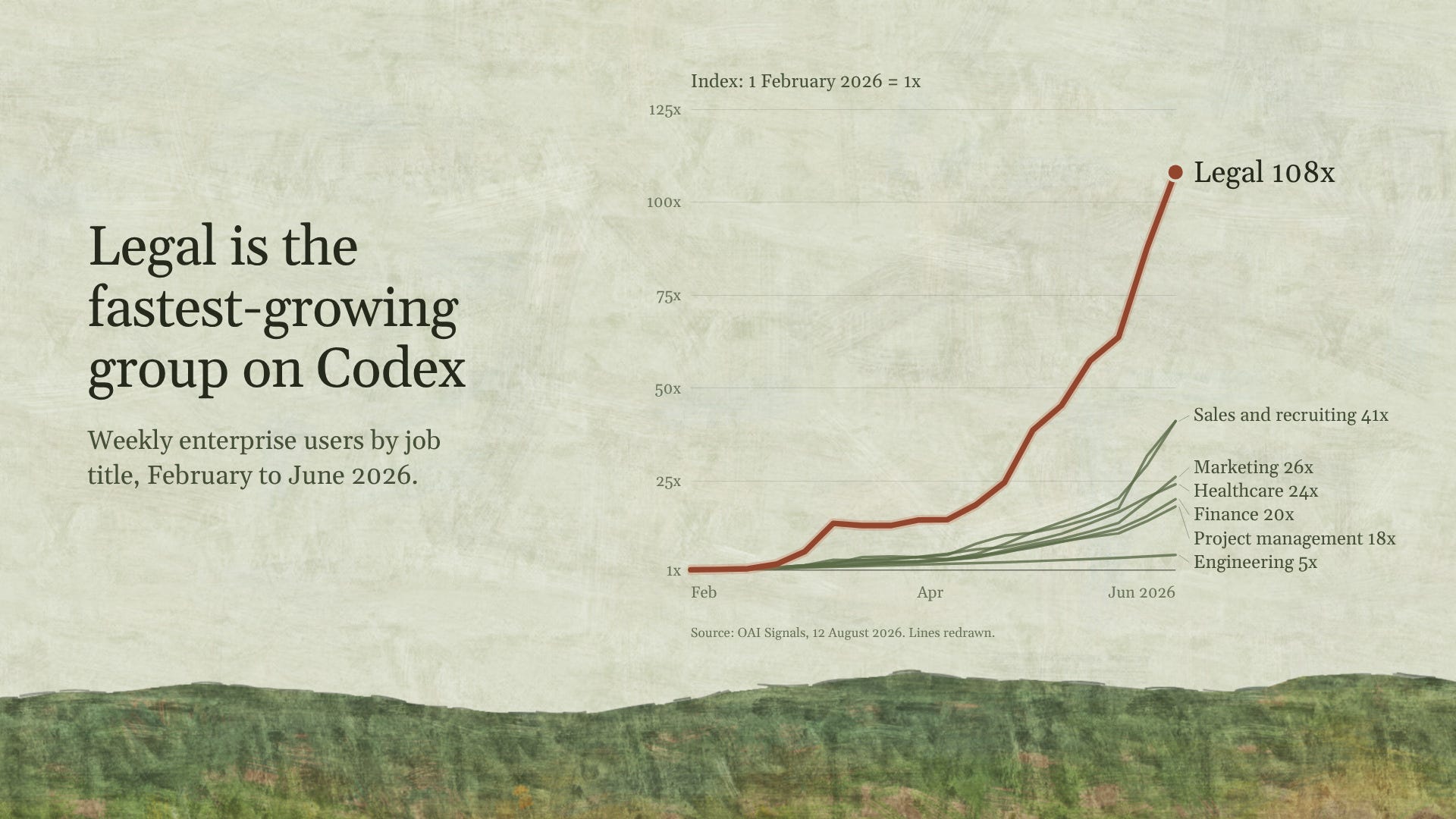
Right now, we seeing a shift in legal. Believe me when I say I would not have believed you if you told me about this graph a year ago.
Lawyers a not as conservative as they are made out to be, but they’re definitely not developers either.
Adopting AI production into a legacy organisational model is happening as we speak. Question is if the follow graph shows actual lawyers doing development in Codex or developers working in law firms. It affects the economics of legal work no matter what the answer is though.
To understand why let’s have a quick look at the model on which the modern large law firm was built.
Cravath
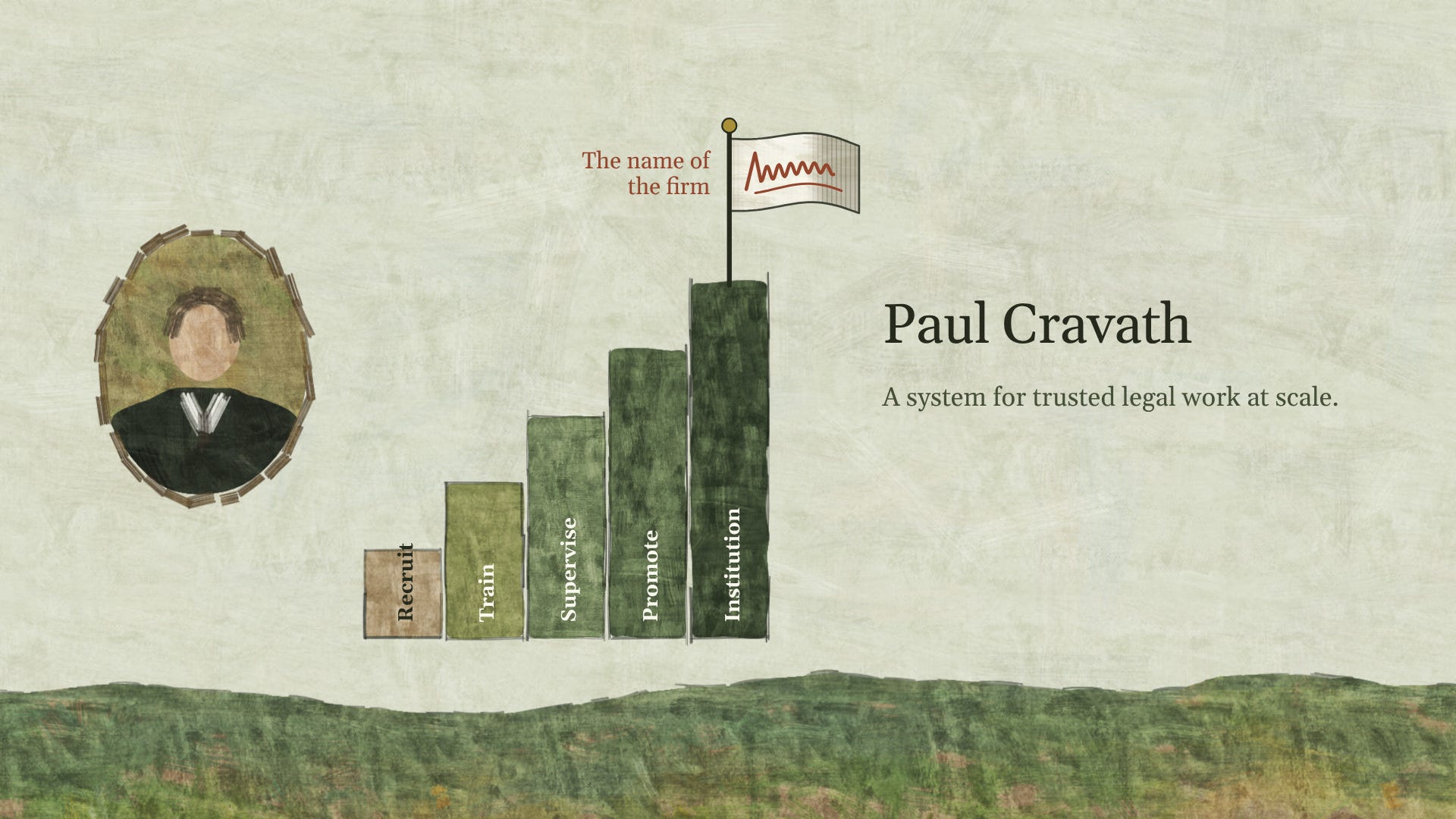
Some 120 years ago, a guy called Paul Cravath helped develop an organisational model that allowed large law firms to meet expanding demand for corporate legal work.
That model became highly influential among major law firms and other professional-services firms.
It followed a clear pattern:
Recruit talented graduates.
Train them through apprenticeship.
Place their work under the supervision of experienced partners.
Promote from within.
As a result the quality of the work was attached to the institution rather than only to the individual lawyer.
Law students can probably thank the influence of the Cravath System for having to attach your grades when you apply to a major law firm.
The system was designed to develop expertise, maintain standards and produce trusted legal work at scale.
It worked. It still works, and law firms will probably continue to operate through some comparable structure.
The Cravath Pyramid
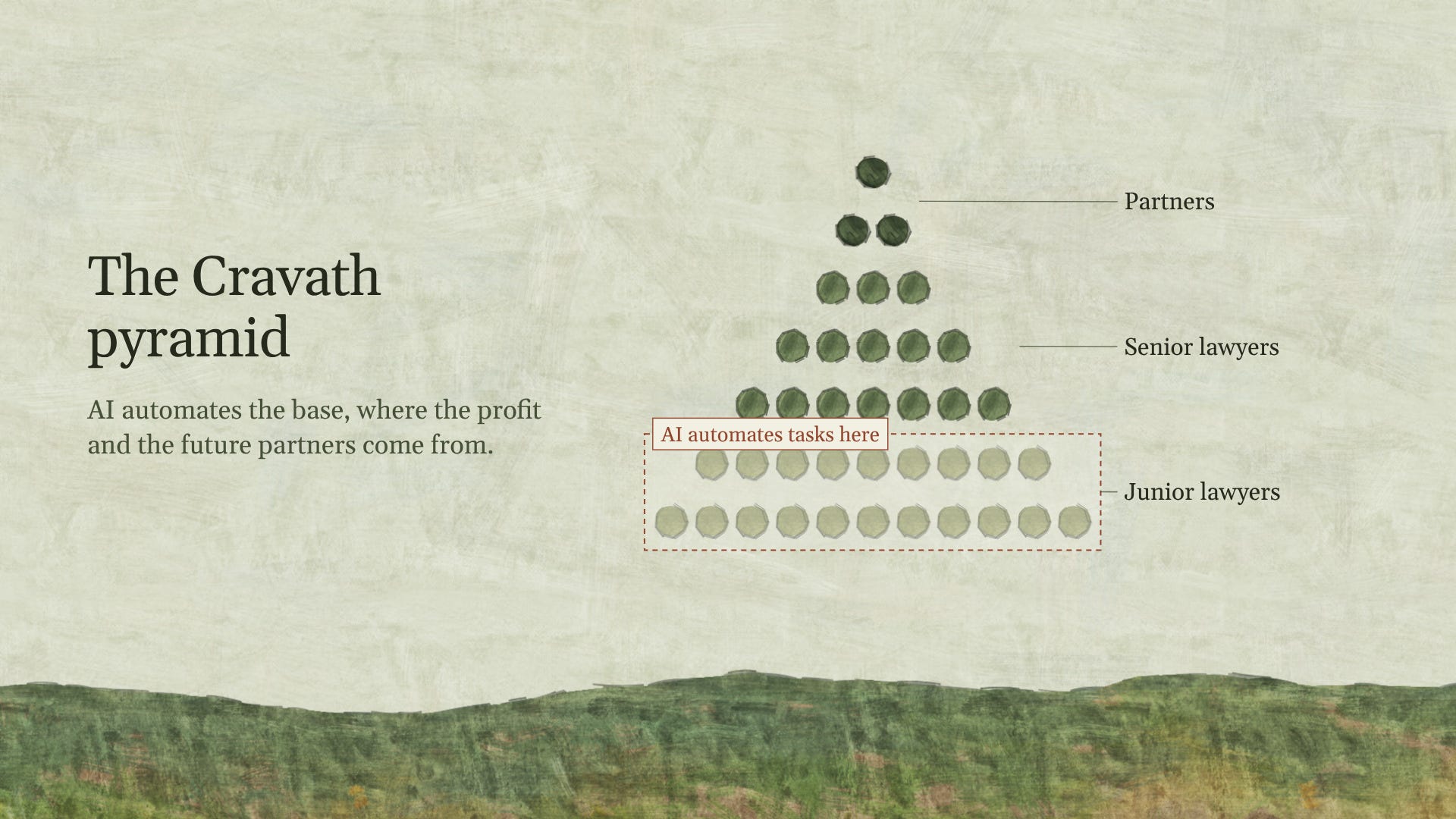
It’s now a familiar pyramid: a relatively small number of partners and senior lawyers supervising a larger number of junior lawyers.
That pyramid makes economically sense when complex legal work requires large quantities of junior human labour, supervised by scarcer and more experienced senior lawyers.
AI currently automates many tasks concentrated near the bottom of that pyramid. At least for now. It therefore interferes with the mechanism through which the firm produces both profit and future talent.
But AI does not, by itself, reproduce the trust infrastructure that recruitment, apprenticeship and supervision created.
It may increase the value of what sits at the top which is
judgment
networks and relationships
accountability and trust.
Among other things of course.
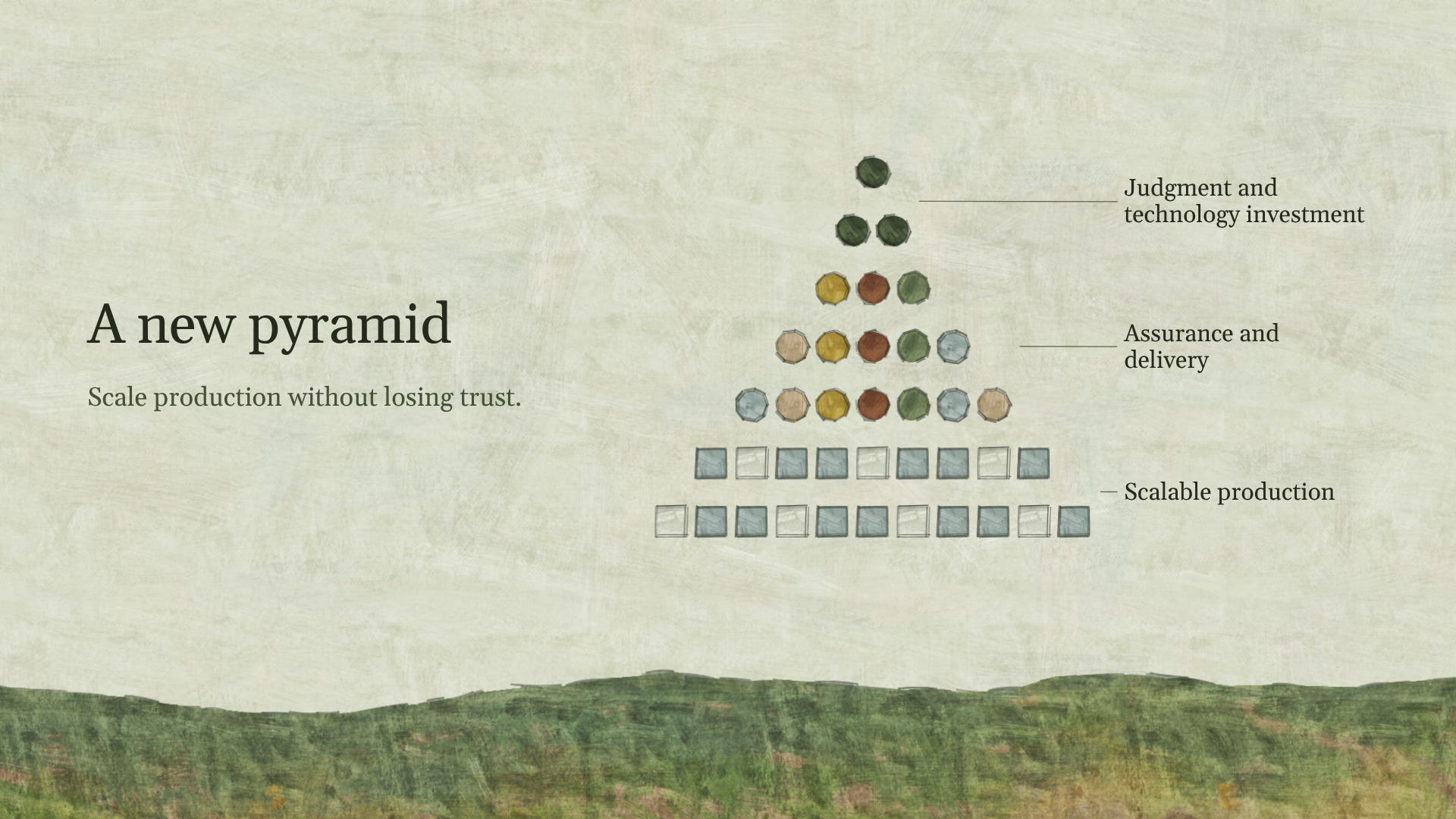
The new pyramid
At the bottom of the new pyramid is is scalable production built for AI. This means models, data, automated workflows and technology platforms. Today, much of that infrastructure is built and supplied by tech companies rather than owned by the professional services firm - especially law firms.
In the middle is the assurance and delivery layer: lawyers working with knowledge specialists, risk professionals, product teams and engineers. Their job is both to operate the technology and to turn its output into a reliable legal service.
At the top, much remains the same: judgment, relationships, accountability, truste etc.
But I would add another important responsibility: technology investment.
As technology continues to grow and becomes a larger part of the law firm’s production model, its leadership must decide which capabilities to build and which to buy. Perhaps more importantly make strategic decisions on which direction to take when nobody knows exactly where the market is heading.
The new org structure will be difficult to implement, but it is more important than ever for law firms to find a way to scale production without losing the sources of expertise and trust that made them competitive in the first place.
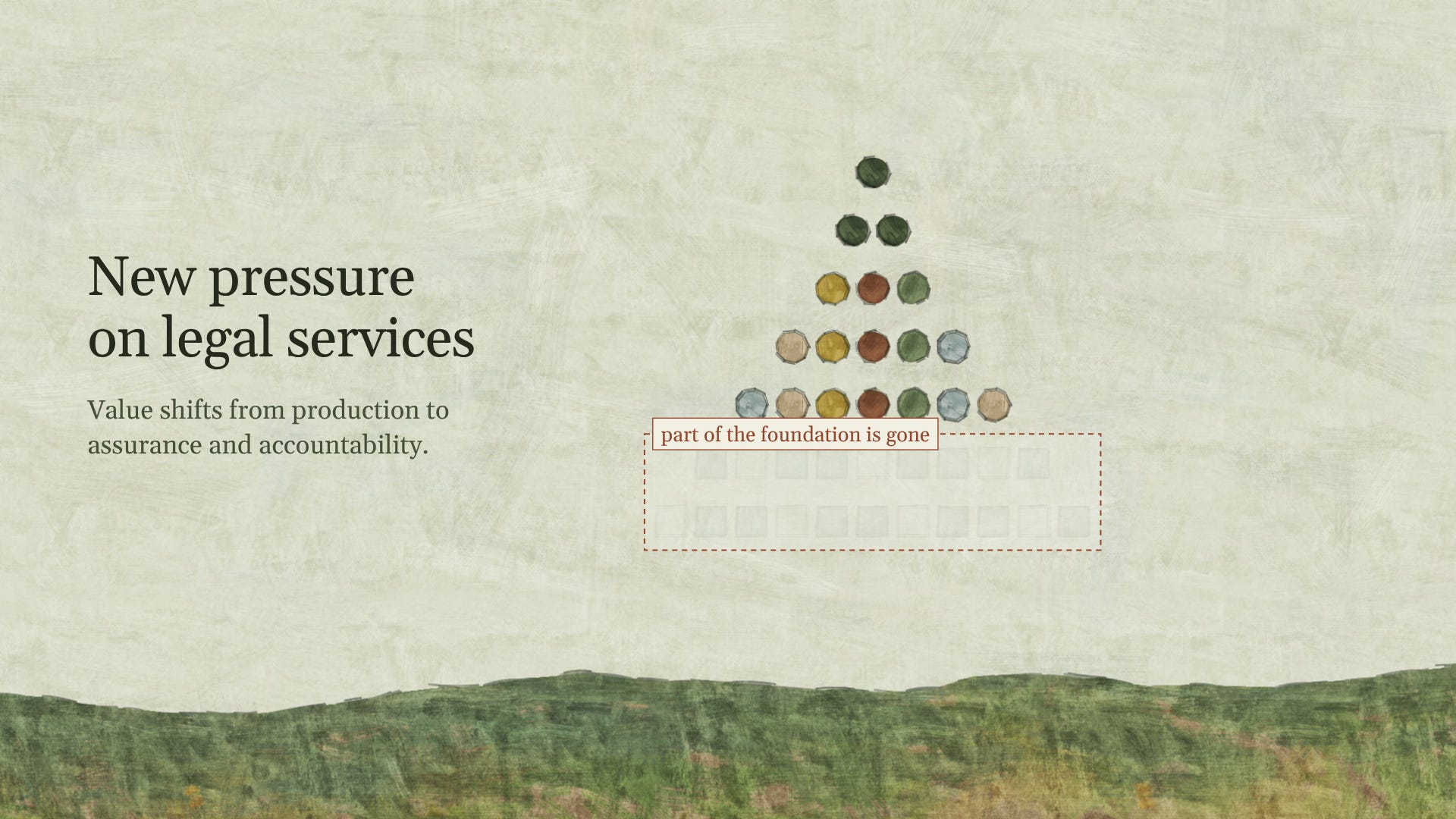
New pressure on legal services
So what’s the situation for legal services?
- AI makes legal output cheaper.
- Trustworthy legal services remain costly.
- Clients question prices and produce more themselves.
- Value shifts from production towards assurance and accountability.
- The traditional pyramid loses part of its economic foundation.
- Firms must redesign how they produce trust, develop experts and capture value.
The future is bright
This brings us to the supposed early adopters: the next generation.
I have had the honour of teaching AI to law students at the University of Copenhagen. We often look to younger lawyers for advice about technology, but my experience is that the same dynamics appear among students as elsewhere.
I conducted surveys to understand what law students actually think about AI.
But how bright?
First, they are eager to learn more. But they also hold back from using these tools in parts of their studies.
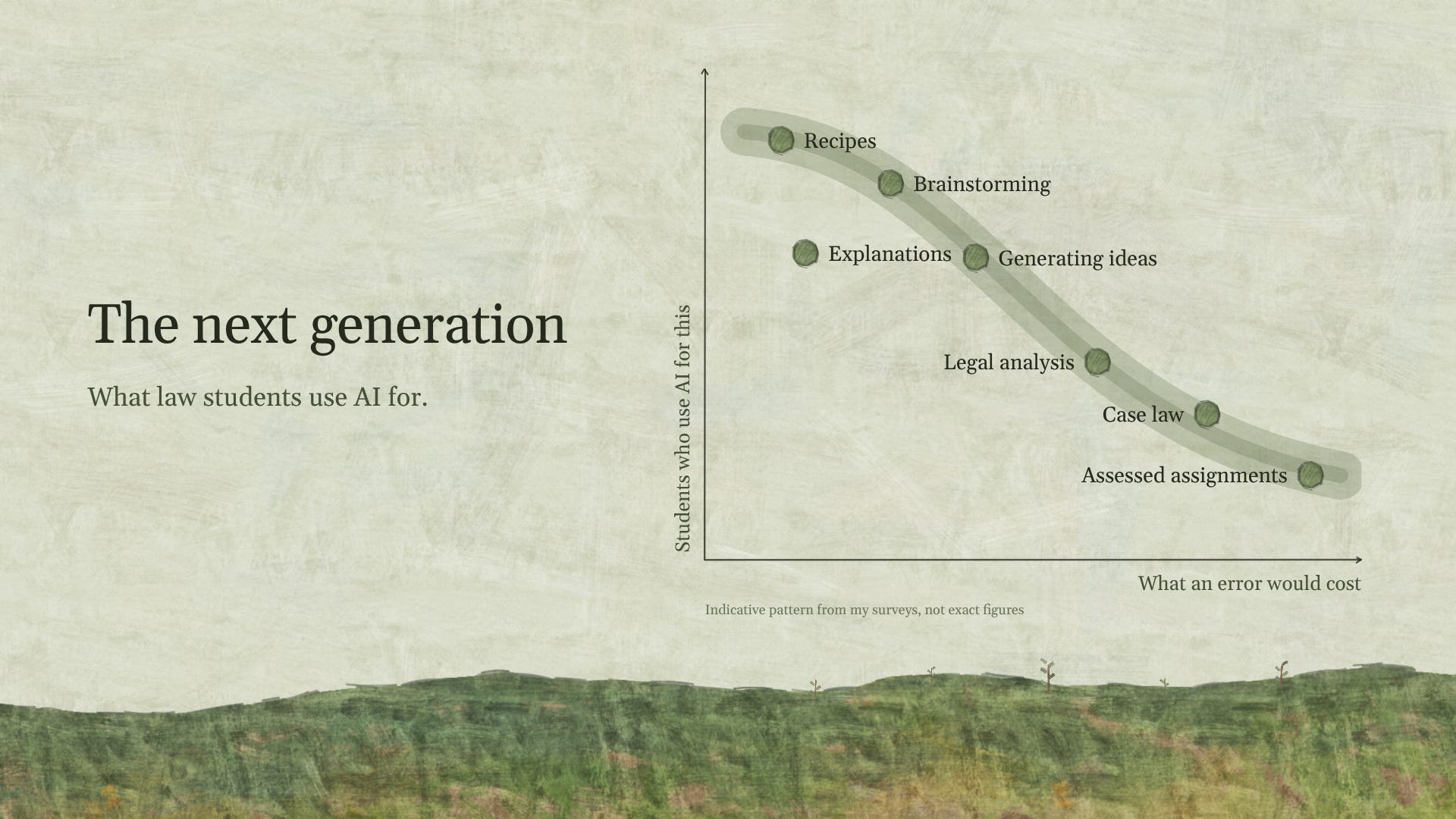
As you can see here law students increasingly use AI, but perhaps not for the purposes that are being promoted by the media.
Low-stakes uses are common: recipes, brainstorming, explanations and generating ideas.
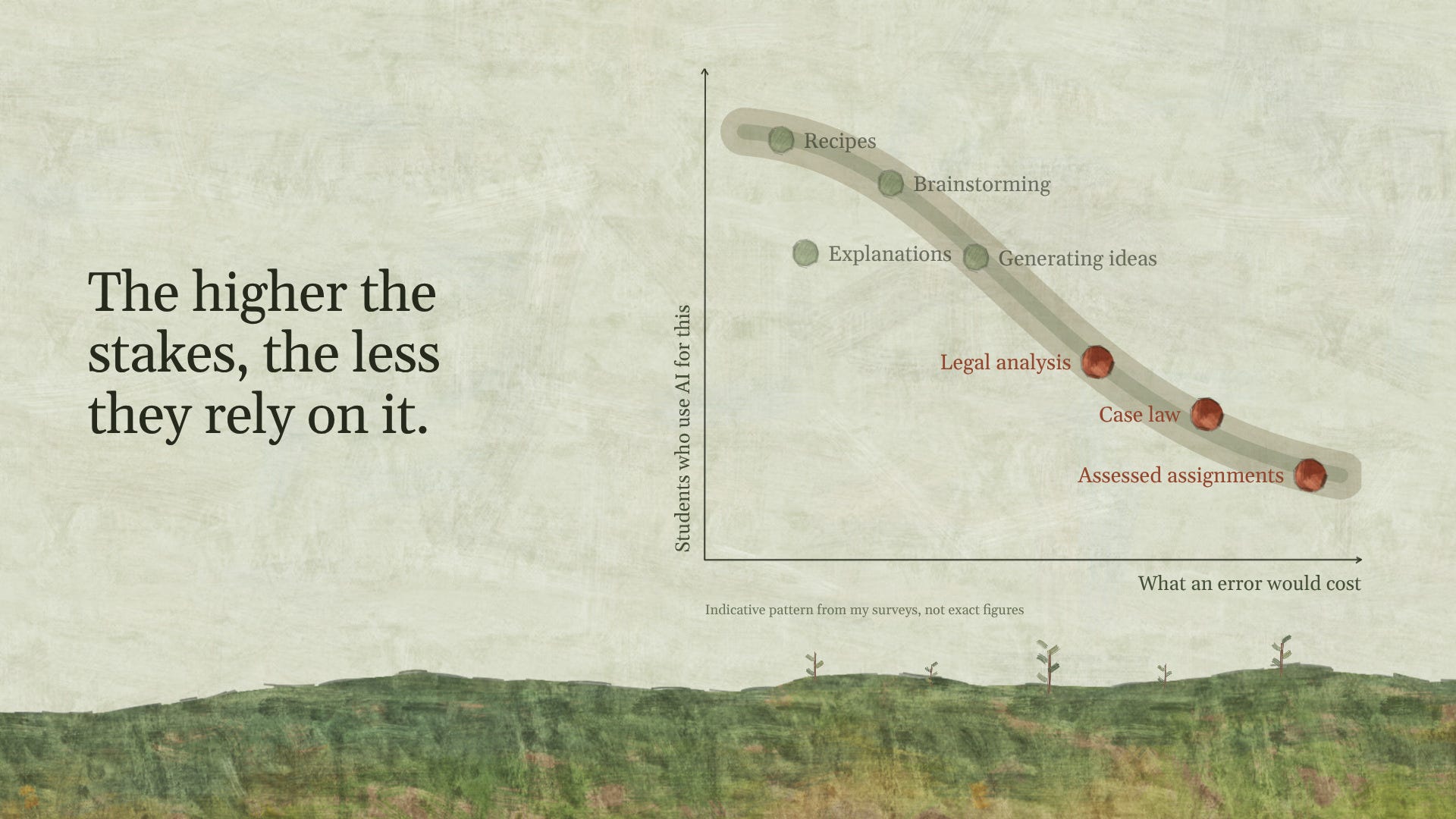
Higher-stakes uses, such as legal analysis, case law and assessed assignments, are less common.
This is my experience at least.
There will always be students willing to use AI to produce an entire assignment. But that was not representative of what I observed in the classroom or in the assignments.
My interpretation is not that these students are necessarily slow adopters. Their behaviour is consistent with intuitively pricing the trust cost of their AI use: the higher the consequence of an error, the less willing they are to rely on the output.
That is a calculation they will probably continue to make in their future lives as lawyers.
But how will future lawyers develop the judgment required to supervise AI-assisted output?
Build a sustainable system
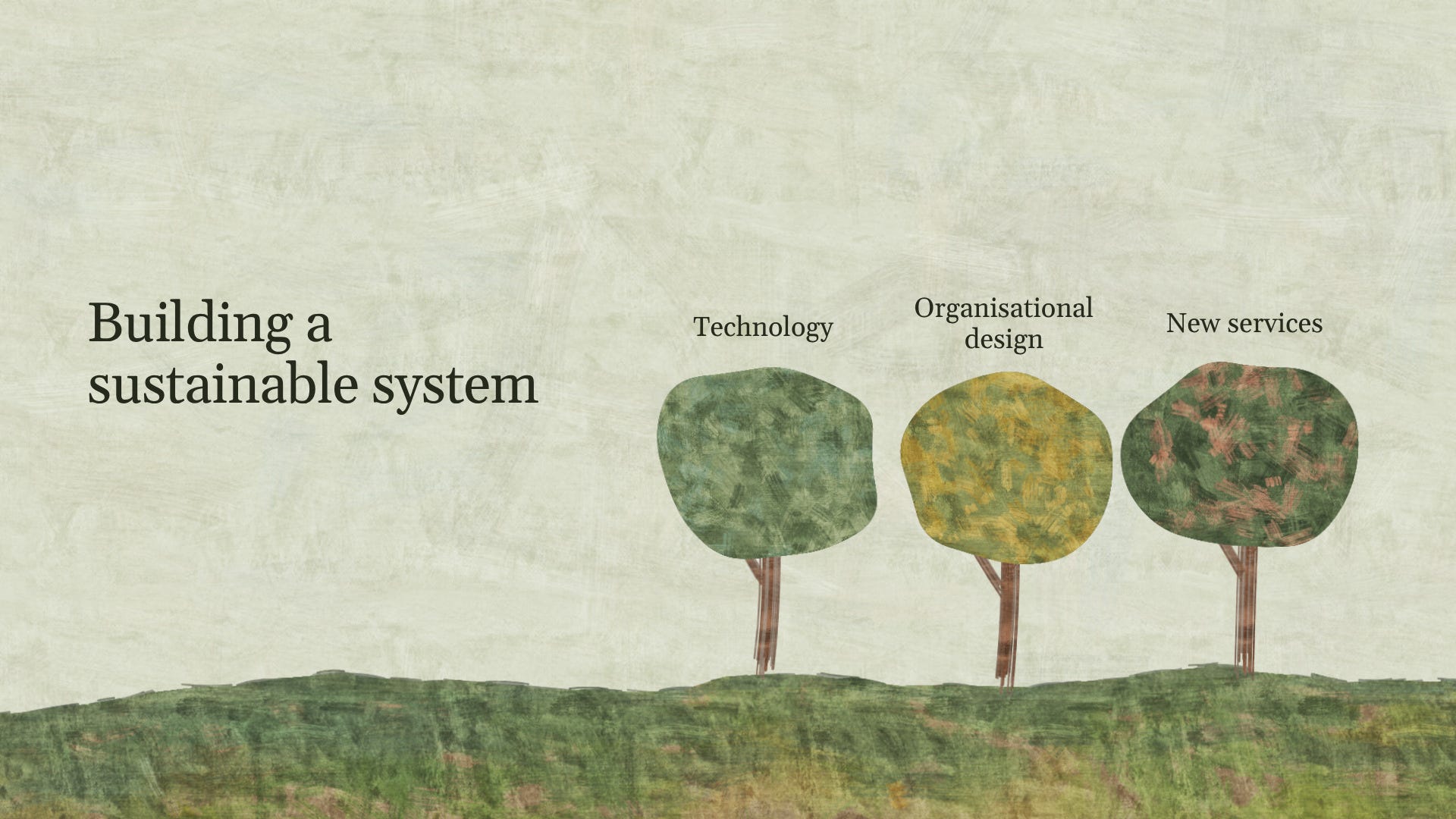
There is no quick fix. What is emerging is a combination of technology, organisational design and new services.
Verification
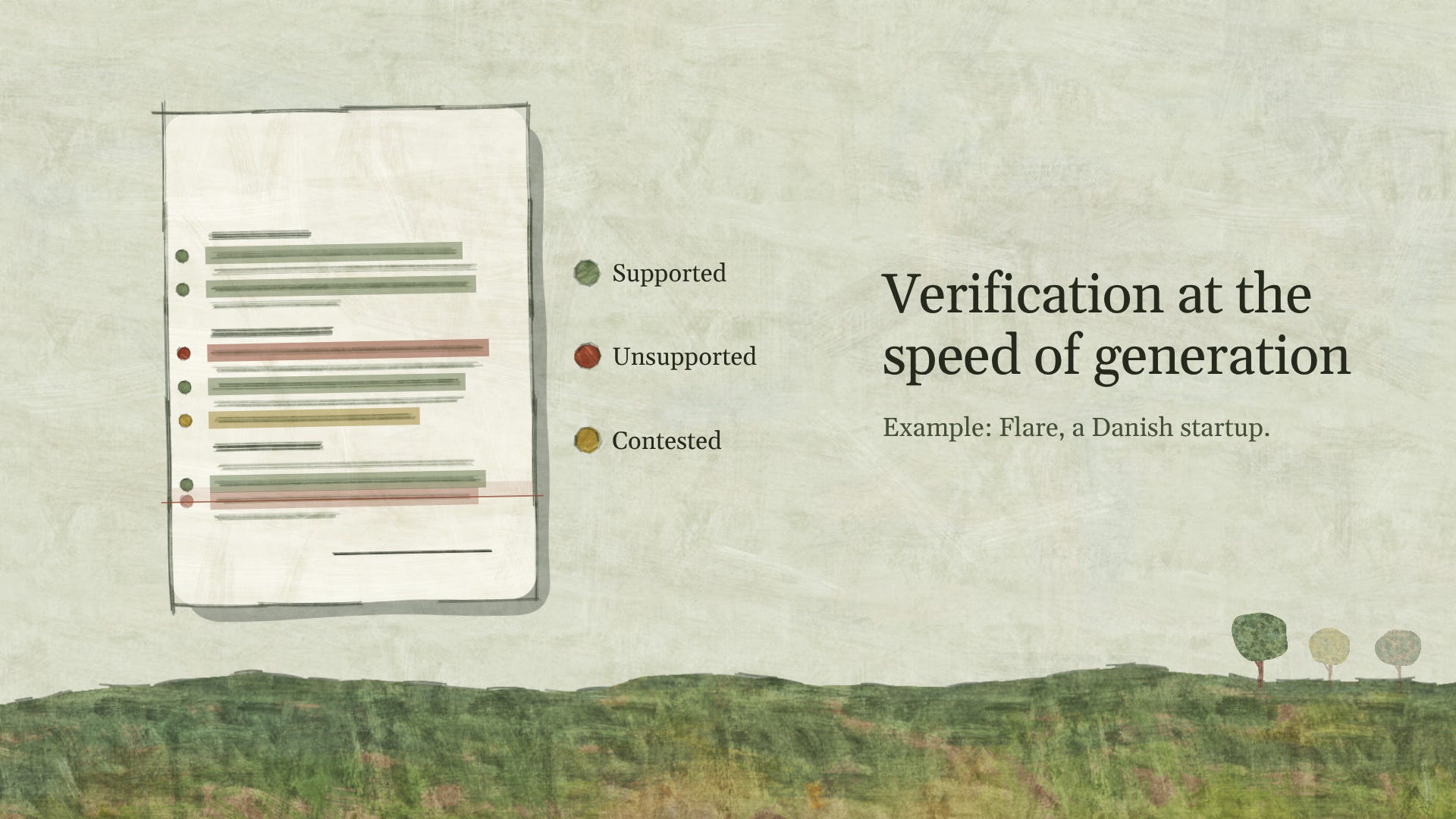
I worked at the office of the Danish startup Flare.
They’re developing infrastructure that evaluates claims and indicates which are supported, unsupported or contested.
It is not built as a legal-verification system, but the direction is relevant to law. If they can make verification happen closer to the speed of generation the time spent on verification will decrease.
Legal AI providers are also developing source-grounding, linked citations, benchmarks and review workflows intended to make generated work easier to verify.
This is the most obvious place to start.
Stop slop
But technology alone is not enough. New policies are also needed.
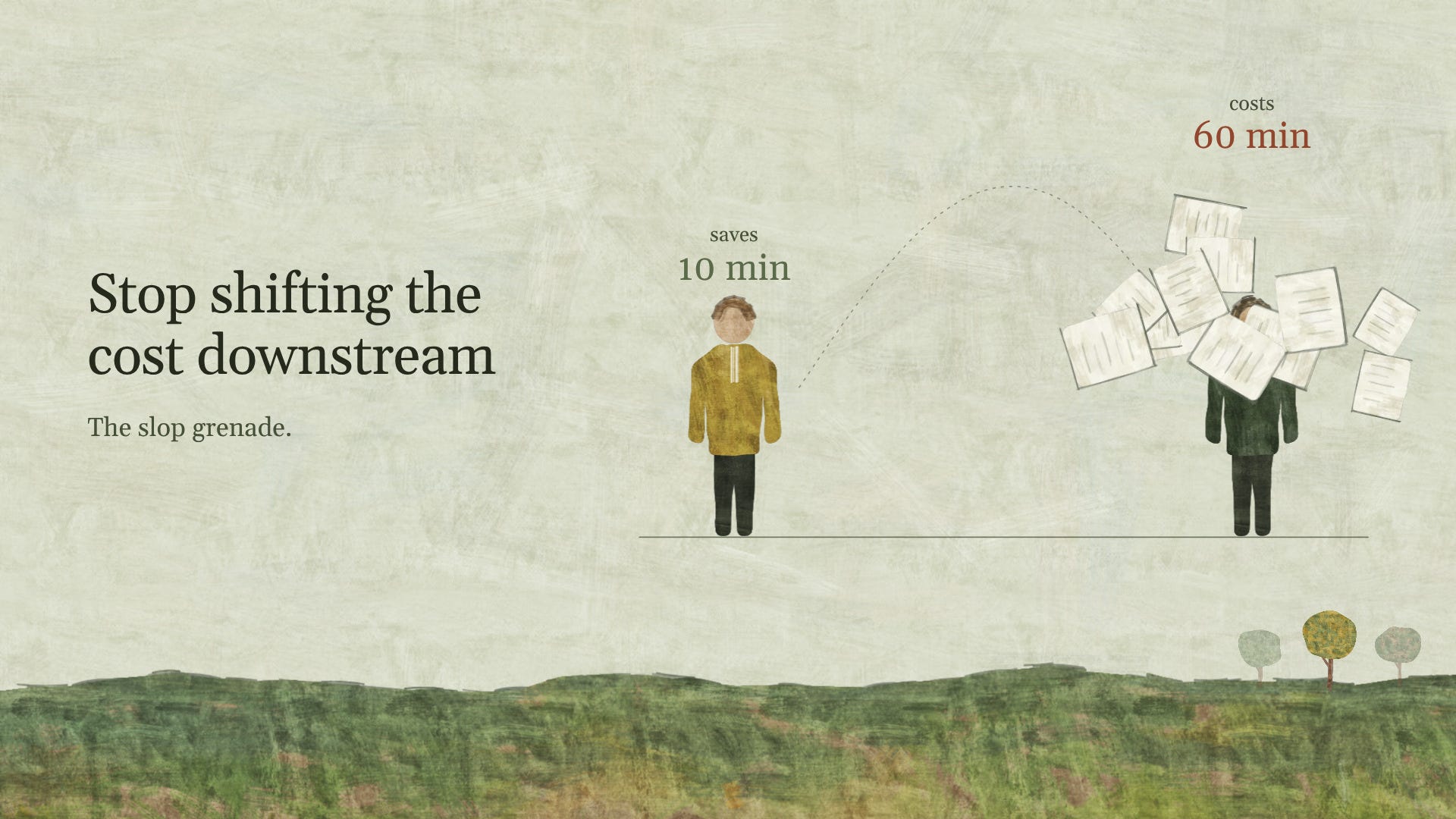
One example is internal company rules against things as “slop grenades”. For those not familiar with the term, I promise you, you’ll be familiar with the shape of it. A slop grenade occurs when somebody saves ten minutes by generating a document they have not read and then transfers an hour of verification work to a colleague, client or court.
If you introduce AI-generated work into a process, you remain responsible for reviewing it before “throwing” it in to the organisation.
A simple “Stop slop” policy would make responsibility follow the output. If you introduce AI-generated material into a legal workflow, you own the first layer of assurance.
That means reading it, checking the important claims against their sources and identifying any assumptions or unresolved questions before handing it to somebody else.
Adopt new learning processes
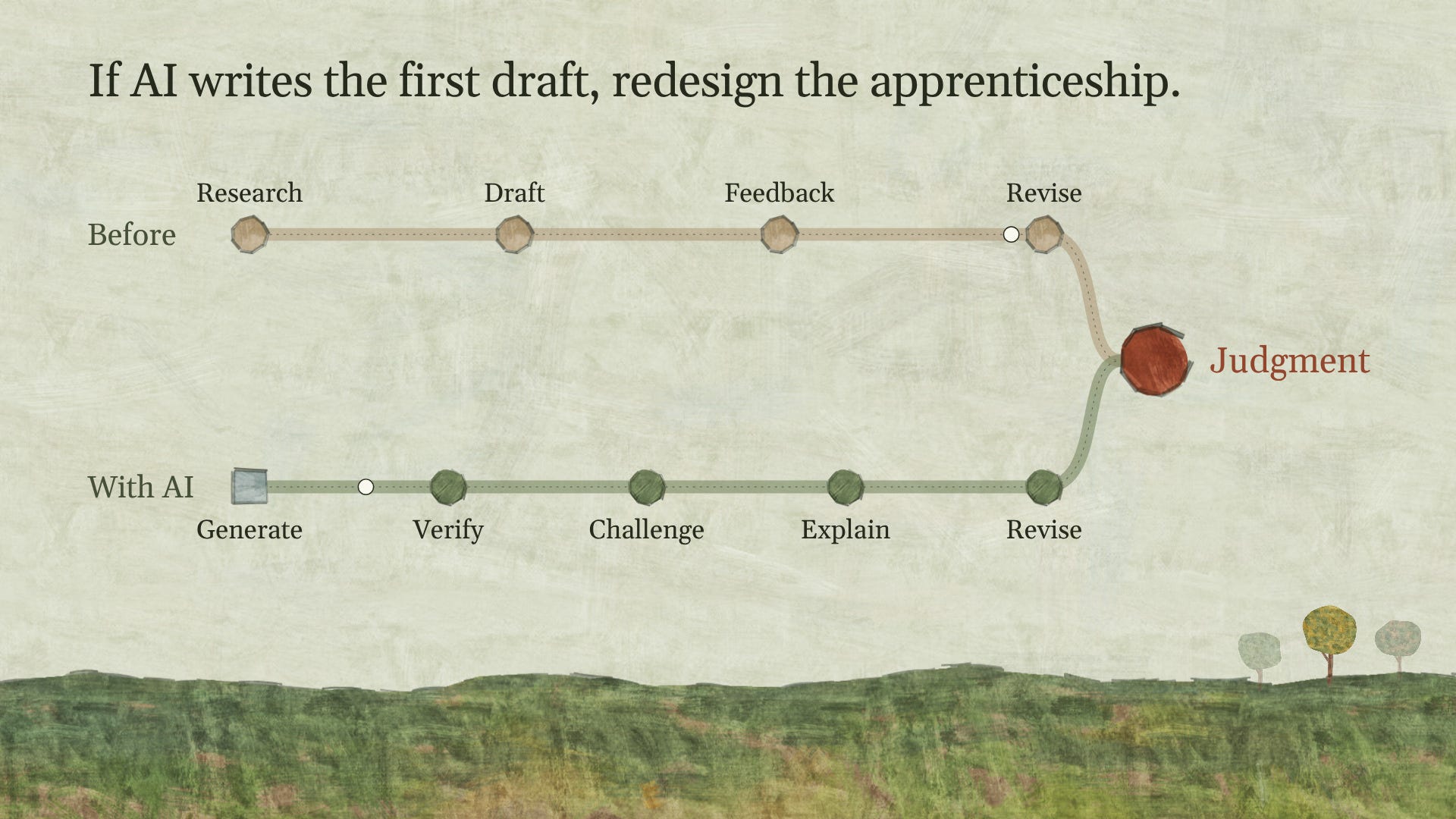
Junior lawyers have traditionally been taken through large amounts of repetitive work: researching, drafting, receiving corrections and trying again.
The repetition is not always efficient, and not all junior work is educational. BUT repeated exposure to feedback from a senior is one of the ways lawyers develop judgment.
If AI produces the first draft, that learning process cannot simply disappear. It must be redesigned around the AI-enabled workflow.
That requires openness about where AI has been used.
Instead of giving a junior lawyer an apparently finished document, a senior might say:
“This draft was produced by AI. Identify every unsupported claim. Trace the legal propositions to primary sources. Find what has been left out. Then tell me whether we should rely on it.”
This can support in keeping the cycle of analysis and feedback going - even with AI.
Create more value
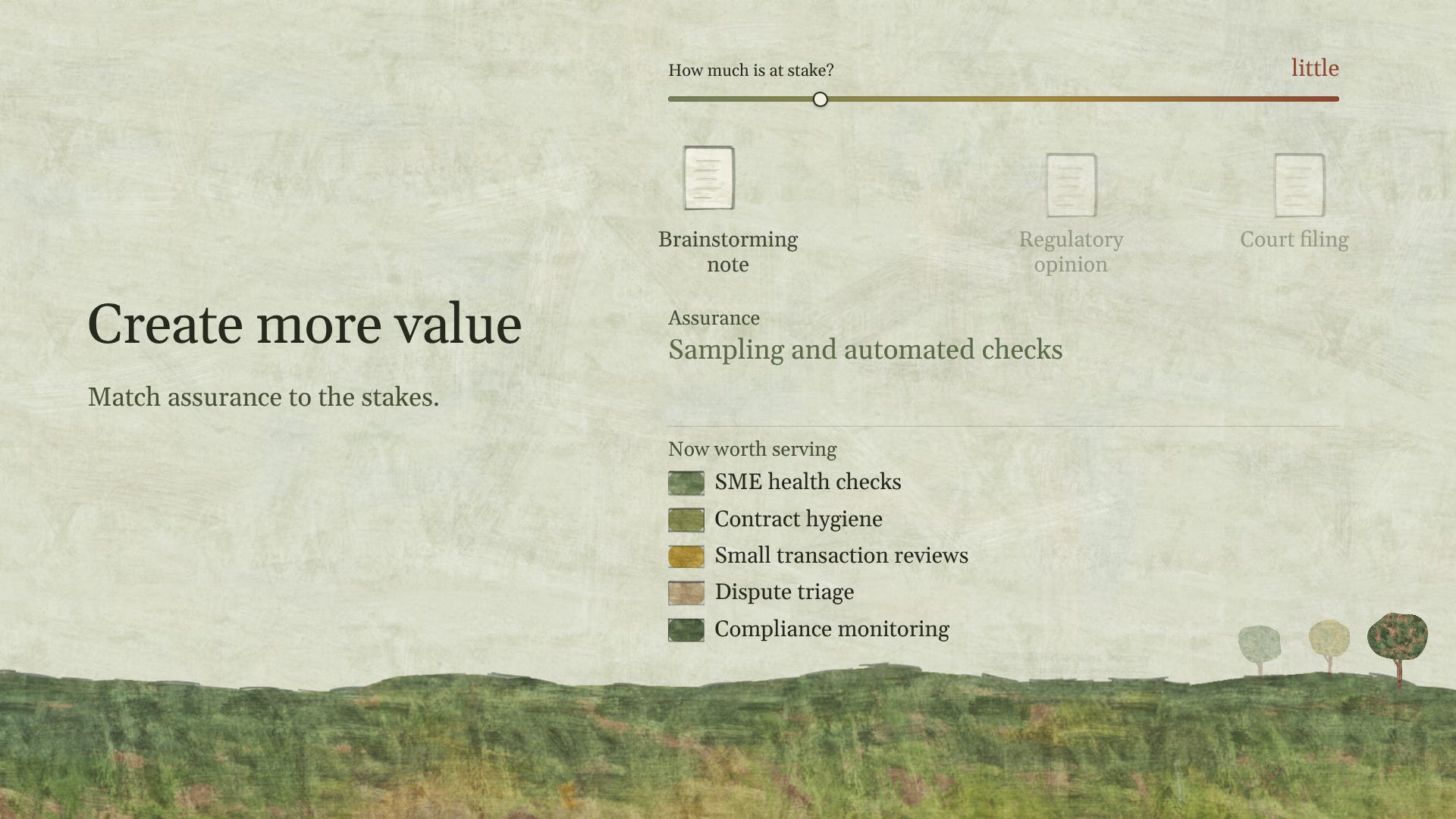
We should also match assurance to the stakes. A court filing and a brainstorming note do not require the same controls.
For high-stakes work, we may need source-by-source verification and senior sign-off. For lower-stakes or reversible work, we may be able to rely on approved sources, automated checks, sampling or exception-based review.
If AI reduces the cost of producing legal work, firms may also be able to serve needs that were previously too small, repetitive or price-sensitive to justify significant lawyer time.
Examples include SME compliance health checks, smaller transactions and low-value dispute triage.
In those services, verification does not disappear, but it may take a different form. Bounded outputs, approved sources, exception lists and escalation to a lawyer when the stakes or uncertainty exceed a defined threshold (which will take time to define).
Technology may reduce the trust cost, but better org design may allocate the verification layer more intelligently. Lower costs may allow lawyers to create value in markets they could not previously serve.
Conclusion
I hope that this presentation has made it clear that AI has enormous potential, but also that much of the work required to turn its output into reliable legal work remains, even if that work changes form.
Facts must still be established. Risks must still be evaluated. Decisions must still be made which means trust and responsibility still has a big role to play.
Right now we’re in a situation where text is becoming abundant, but as you might be able to guess legal AI will not be decided by which system can produce the most text.
Hopefully it will be decided by which organisations can turn that output into trust, without destroying the process through which the next generation learns to provide them.
Because, in the end, the most valuable part of this document is not the text at the top, but someone is willing to put their name at the bottom.
Originally published on Substack →